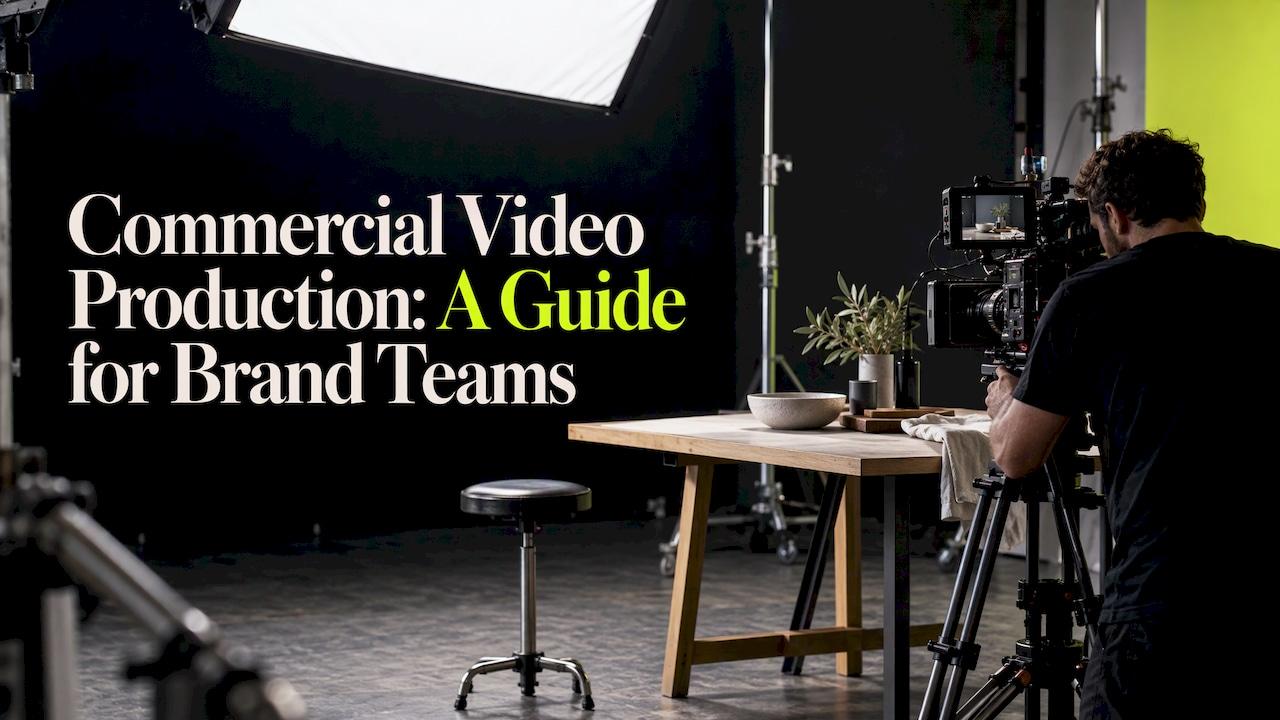
Commercial video production is the making of a film that sells, explains or builds a brand, from the first brief to the last delivered file. For a large brand team or an agency, the real work is not one good shot. It is keeping a film consistent from concept to every cut-down, on brand, and within broadcast and platform specifications. That is the case for an integrated approach: AI production built on live-action and post-production craft, with human creative direction on every decision.
TL;DR
- Commercial video production covers brief, concept, pre-production, shoot or generation, post-production, approvals and delivery to each channel.
- Most delays come from vague briefs, unplanned versions and late legal or music clearance, not from the shoot.
- A realistic commercial schedule runs roughly 7 to 11 weeks, according to published industry guides.
- Plan one campaign across screens, not one film: lengths, formats and measurement are decided up front.
- AI-augmented production adds speed and range only when documented workflows and human direction keep the output consistent and broadcast-ready.
Table of Contents
- What commercial video production covers
- Formats: what you are actually commissioning
- Who does what: brand, agency and production company
- The stages, step by step
- How long it takes
- Budget and scope: what to plan for
- Plan for channels and measurement
- Where AI-augmented production fits
- How Craft Intelligence handles it
- Briefing checklist for your next commercial
- FAQ
- Sources
What commercial video production covers
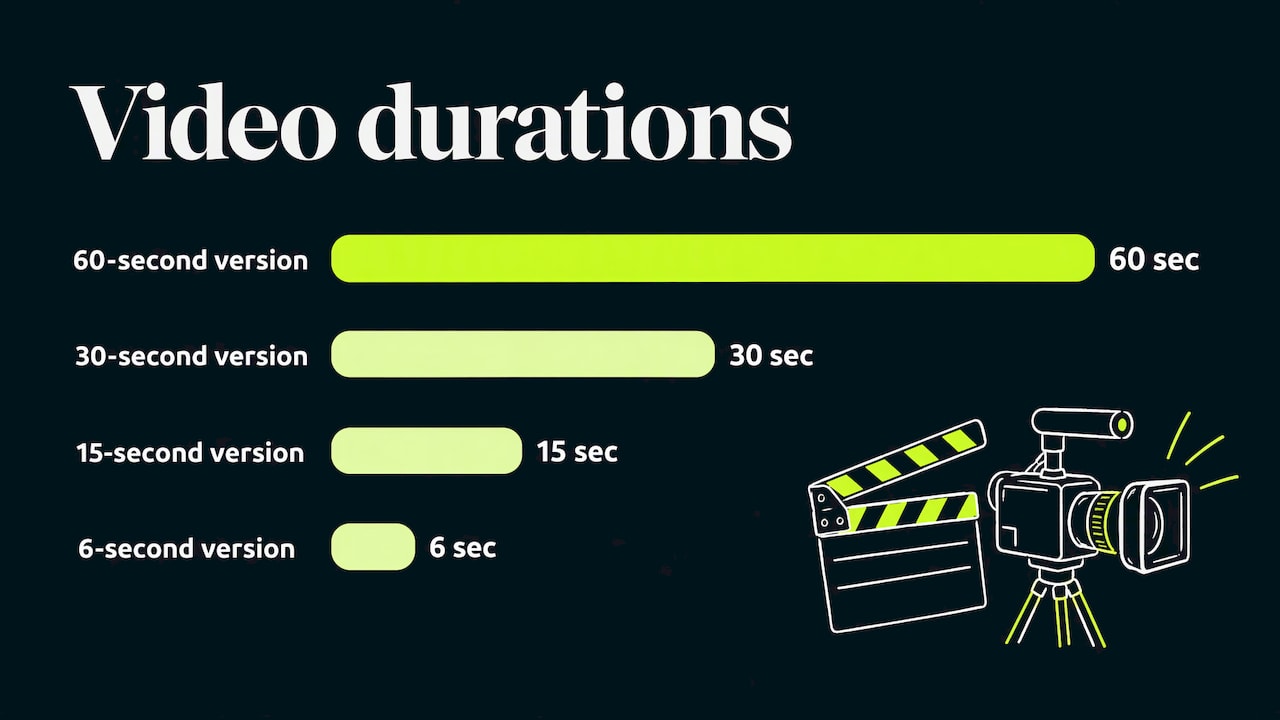
It is the full process of making video content, from creative ideation through to execution, for a commercial purpose. Typical outputs are brand films, promotional videos and digital out-of-home content. Brand ads often come as 60-, 30- or 15-second versions for broadcast TV, streaming, online video or social.
The goals vary. In Wistia's 2022 survey, respondents most often named driving brand awareness (22.4%) as a video goal, followed closely by product education at 21.6%. In complex B2B sales, LinkedIn's B2B Institute argues in its 2026 white paper that video can simplify complexity, build trust and help buying groups align, so awareness-only measurement can miss its business impact. The same paper reports video appeared in 62% of 2025 LIONS campaign submissions, against 38% in 2010. That finding concerns award entries, not all campaigns.
Formats: what you are actually commissioning
The format decides the creative, the length and the delivery spec. Shopify's guide separates in-stream ads, which run before, during or after video content, from out-stream ads, which appear in articles and feeds and often start without sound. It also describes native ads, paid social placements and OTT ads, which are commercials delivered over the internet to streaming services and devices.
In practice a brief should list:
- the hero film and its cut-downs (for example 60, 30, 15 and 6 seconds);
- aspect ratios per placement (16:9, 9:16, 1:1);
- sound-off versions with burnt-in subtitles;
- localised versions for each market;
- broadcast masters and clearance paperwork.
IAB Australia's guidance is to match creative length to platform, audience behaviour and objective rather than assume every asset needs the same duration. Decide this before the shoot, because it shapes framing, coverage and the edit.
Who does what: brand, agency and production company
On most large commercials there are two agreements: one between brand and agency, and one between agency and production company. The European guide to advertising commercial production says a client-side individual should own briefing and approvals.
The usual division of labour:
- Client: briefs the agency in writing on objectives, requirements and marketing strategy, agrees budget and timetable early, and names one approver.
- Agency producer: draws up the schedule, coordinates production-company briefings and monitors spend.
- Production company: quotes, shoots and completes post-production, with client approvals at set stages.
Brands that work directly with a production studio compress this chain. Agencies often bring a studio in for specialist capacity, such as VFX, grading or versioning, while keeping the creative lead.
The stages, step by step
Amazon Ads describes a workflow running from creative brief and concept through script, storyboard, pre-production, production, post-production, rights, localisation and channel delivery. Here is each step with where it tends to go wrong.
1. Brief
A useful brief sets out purpose, goals, requirements, messaging, audience, deliverables and localisation needs, supported by brand guidelines and examples, according to the same guide. It goes wrong when deliverables are left open. Every added version later becomes a change request.
2. Concept, script and storyboard
This is where the idea is tested against the brief. Storyboards and animatics let approvers see problems while changes are still cheap. Get written sign-off on script and budget before anyone is booked.
3. Pre-production
Casting, locations, crew, design and, for AI-augmented work, the workflow itself: which tools generate what, who hands what to whom, and which creative controls keep characters, products and brand colours consistent. Skipping this step is how a film ends up looking like five different films.
4. Production
In a live-action commercial, the shoot typically lasts one to five days according to Belgium's BCP production guide. Where AI generation is part of the pipeline, this stage includes generating and selecting material under the director's eye, then capturing plates or elements that must be real.
5. Post-production
Editing, effects, sound design, voice-over, music and preparation for distribution. BCP assigns the production company responsibility for overseeing and executing post-production. It also warns that extensive VFX, music composition or music clearance need extra time, and recommends planning them, and their costs, from the outset.
6. Approvals and delivery
Approvals should happen at defined stages: offline edit, online finish and final master. Delivery means broadcaster-compliant masters, social cut-downs and a clean archive. Late changes at this point are the most expensive in the project.
How long it takes
Published timetables give a useful range. The WKO guide's minimum cost-effective schedule covers seven production weeks, from creative briefing through script and budget approval, production-company selection, pre-production, shoot, offline and online finishing, to delivery to broadcasters. BCP's representative schedule is about 11 weeks: roughly three weeks of pitching and pre-production, a shoot of one to five days, around three weeks of post-production, delivery in week 10 and campaign start in week 11.
Use these as planning ranges, not promises. Clearance, VFX-heavy finishing and multi-market versioning all stretch the post-production block.
Budget and scope: what to plan for
A 2014 checklist from CP+B recommends budgeting for changes, specialists, travel and project-resource hours and defining approvals and change requests up front. BCP adds that the brief and offer should specify the number of versions and deliverables, and that extra versions or changes beyond agreed scope require a revised estimate and approval.
A practical scope sheet for a brand team:
| Item | Decide before kick-off |
|---|---|
| Hero film length and cut-downs | Exact durations and ratios |
| Versions | Number, languages, markets |
| Music | Library, commissioned or licensed |
| VFX and compositing | Shot count and complexity |
| Approvals | Named approver, stages, rounds |
| Delivery | Broadcast specs, platform specs, archive |
| Legal | Clearances, talent and usage terms |
Plan for channels and measurement
The CP+B checklist frames commercial video as an integrated, multiscreen campaign rather than a single film, tying asset planning to media delivery, legal clearance, analytics and launch. Measurement needs the same early thought. IAB Australia's 2026 survey of 78 agency decision-makers found that nine in ten agencies have a unified strategy across screens, while 25% rarely or never unify measurement. The same report says 62% use digital brand-lift studies to assess digital video.
To isolate what the creative itself achieves, IAB Australia recommends controlled test-and-control experiments, noting that sample sizes get harder to reach as creative and channel combinations multiply. That is another reason to fix the version plan early.
Where AI-augmented production fits
Getting a good shot from a single prompt is the easy part. The hard part is turning AI output into a finished film that holds together from start to end, stays on brand and meets broadcast and agency delivery specs. Output from one tool rarely does that alone. It takes several tools orchestrated together, clear handoff standards between specialists and quality checks documented at each stage.
For a brand team that means the speed and range of AI with the standards of a live-action shoot: directors, AI artists, editors and colourists applying judgement where it matters, so the film that reaches you is ready to go live.
How Craft Intelligence handles it
Craft Intelligence is BearJam's production system for AI-augmented video. BearJam is an award-winning London video production studio founded in 2012. The system combines specialist people, AI tools and tested production processes, with human creative direction steering every decision. It covers workflow design, handoff standards, creative controls, versioning, VFX, compositing, conforming and grading for brand-safe, broadcast-ready deliverables.
It is built for brand marketing teams, agencies and media owners. Agencies can bring it in for the stages where AI and finishing craft matter most, and brand teams can brief it directly. See the AI production service to start a project.
Briefing checklist for your next commercial
- One named approver on the client side.
- A written brief with purpose, audience, messaging and brand guidelines.
- A full deliverables list, including versions and languages.
- Early decisions on VFX, music and clearance.
- Approval stages and a change-request process agreed in advance.
- A measurement plan chosen before the edit is locked.
FAQ
What is the difference between a video ad agency and a production company?
An agency usually develops the idea and strategy and manages the client relationship. The production company quotes, shoots and finishes the film, with client approvals at set stages. Many projects involve both, with agreements between client and agency, and agency and production company.
How much should I plan for a commercial video?
Cost depends on length, versions, VFX, music and talent, so it is set by the scope sheet rather than a standard rate. Specify the number of versions and deliverables in the brief, because extra versions beyond scope need a revised estimate. For a Craft Intelligence project, scope and price are agreed per project.
How long does commercial video production take?
Published industry guides show about seven weeks as a minimum cost-effective schedule and about eleven weeks as a representative average from pitch to campaign start. Heavy VFX or music clearance adds time.
What should a commercial video brief include?
Purpose, goals, requirements, messaging, audience, deliverables and localisation needs, plus brand guidelines and reference examples. Name the approver and agree budget and timetable early.
Sources
- What is Video Production? How the Process Works, Amazon Ads
- Video Buyability white paper, LinkedIn B2B Institute, 2026
- 2022 State of Video Report, Wistia
- What Is Video Advertising?, Shopify
- European production of advertising commercials, WKO
- Production guide, BCP Belgium
- New School Video checklist, CP+B
- Video State of the Nation 2026, IAB Australia
- Creativity in Video, IAB Australia, 2021