A creative test is only as good as the versions you put into it. Plan the hypothesis, budget and metrics well, and you still learn nothing if the variants differ in five ways at once, drift off brand or cannot be delivered to spec. For brand teams and agencies, the real work is producing a set of video variations that are cleanly different, consistently finished and ready to run. That is the part we build at Craft Intelligence, BearJam's production system for AI-augmented video, where human creative direction steers every decision and quality checks are documented at each stage.
This guide covers what creative testing is, how to plan a test that gives a usable answer, which elements to vary, how to produce video variations without losing control, and how to read the results.
TL;DR
- Creative testing shows which execution, whether a cut, hook or message, works on your audience, either before launch with real people or after launch through live experiments.
- Change one variable per test. If hook and visual change together, a win cannot be explained.
- Write the test card before production: question, hypothesis, single change, metric, spend limit and decision rule.
- Variations need a controlled production process so that the only difference between versions is the one you chose to test, and everything else stays on brand and to spec.
- Do not call a winner early. Wait for enough conversions and a stable result across several days.
Table of Contents
- What advertising creative testing is
- Plan the test before anything is produced
- Decide what to vary
- Producing video variations that stay comparable
- Where AI-augmented production fits
- Reading the results
- Common mistakes and how to avoid them
- FAQ
- Sources
What advertising creative testing is
Creative testing means evaluating ads with real audiences to see how well they communicate, persuade and perform. It can be done before a campaign goes live, by showing ads, video or messaging to real people and measuring attention, message clarity, relevance, emotional response, brand recall and purchase intent. It can also be done during a campaign, by running different versions of an ad's images, video, copy or format against each other to see which performs best.
The two approaches answer different questions:
| Approach | When | What it tells you |
|---|---|---|
| Pre-testing (concept or survey-based) | Before media spend | Which concept or cut is strongest with the intended audience, and whether the message and brand come through |
| In-market testing (A/B, multivariate) | During the campaign | Which version delivers better clicks, conversions or cost per result |
| Lift testing (test group versus control) | During or after the campaign | What the creative actually added to awareness, consideration or purchase intent |
The pre-launch survey approach complements post-launch A/B testing by picking the strongest concept before media money is committed. Conversion lift testing against a control group is a third structure alongside split and multivariate tests.
Why it matters to large brands
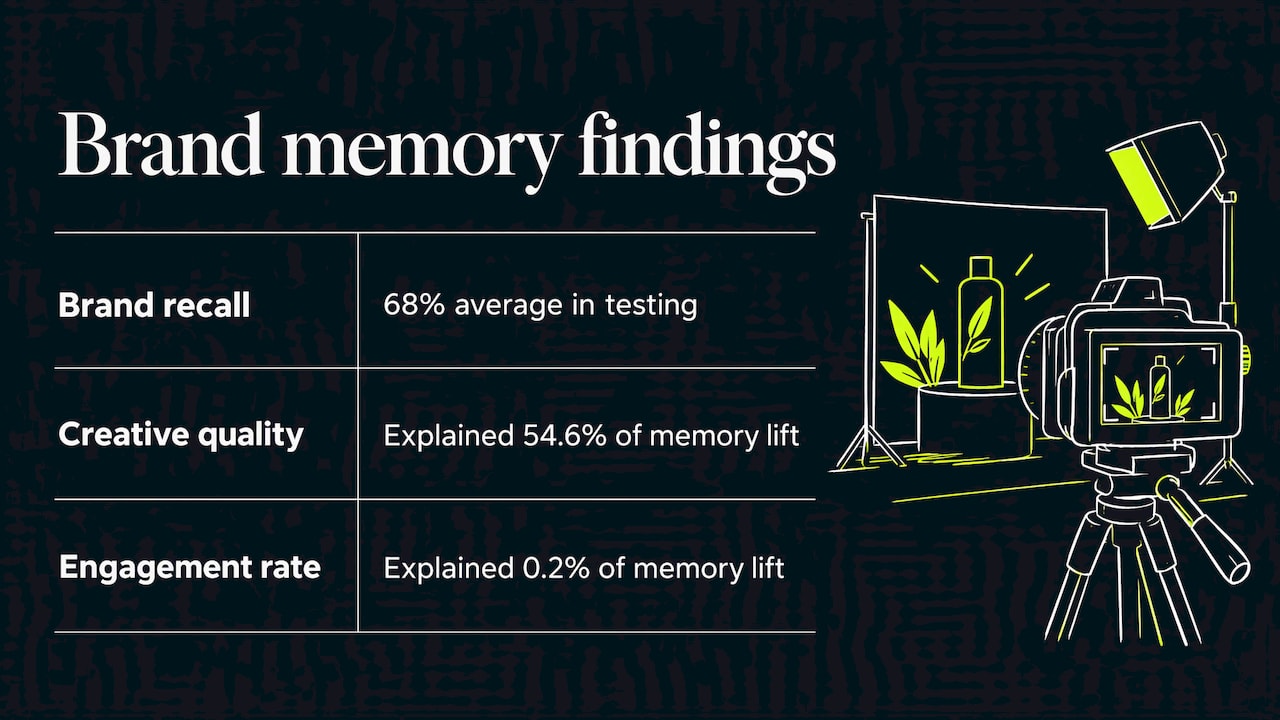
Creative decides whether anyone stops and responds, and regular testing supplies fresh work that counters ad fatigue, the disinterest that comes from overexposure to repeated content. There is also a brand-building angle. One US benchmark report puts average brand recall in a testing environment at 68%, which implies about a third of media spend is not reinforcing the brand. A test that only tracks clicks can miss that.
A large body of analysis points the same way on what drives memory. A study of 129.6m engagements against 231 TikTok brand lift studies across the UK, Brazil, Italy, Mexico, France, Spain, Germany and the US found that creative quality explained about 54.6% of brand memory lift, while engagement rate explained about 0.2%. The craft of the asset matters far more than the surface metrics suggest.
Plan the test before anything is produced
Most failed tests fail at the planning stage. Three habits fix most of it.
Write a hypothesis and a test card
A useful hypothesis follows an If, Then, Because pattern, with a primary metric, secondary metrics and a defined target audience. IAB Australia's guide to digital ad impact studies recommends exactly this and notes that controlled experiments need enough sample volume.
For example: If we open the film with the product in use rather than the brand logo, then 3-second view rate will rise, because the benefit is visible before viewers scroll.
Turn that into a test card before production starts. A practical test card covers the question, hypothesis, the single change, how it will be measured, spend limits and a decision rule. Writing it first matters for production: it tells the edit and post team precisely what must differ between versions and what must not.
Set budget and sample realistically
Sample requirements are the point where ambition meets money. One widely used playbook suggests a minimum of 1,000 conversions for a two-cell split test, so at a $10 cost per acquisition the budget is $10,000. It also says cells should spend equally and only one difference should exist between them.
Other frameworks use lower working thresholds for iteration. One recommends at least 50 conversions per variant before calling a cost-per-acquisition winner, a minimum of three to four days' run time and a 90 to 95% confidence target. Another sets 10,000 impressions per variant for diagnostic metrics and seven days minimum duration, and suggests ring-fencing 10 to 20% of ad spend for testing. These figures come from practitioners rather than standards bodies, so treat them as planning ranges and agree your own thresholds with your media team before launch.
For survey-style pre-tests, 100 respondents is a common minimum guideline, with larger samples if you need to compare audience segments.
Choose metrics that match the question
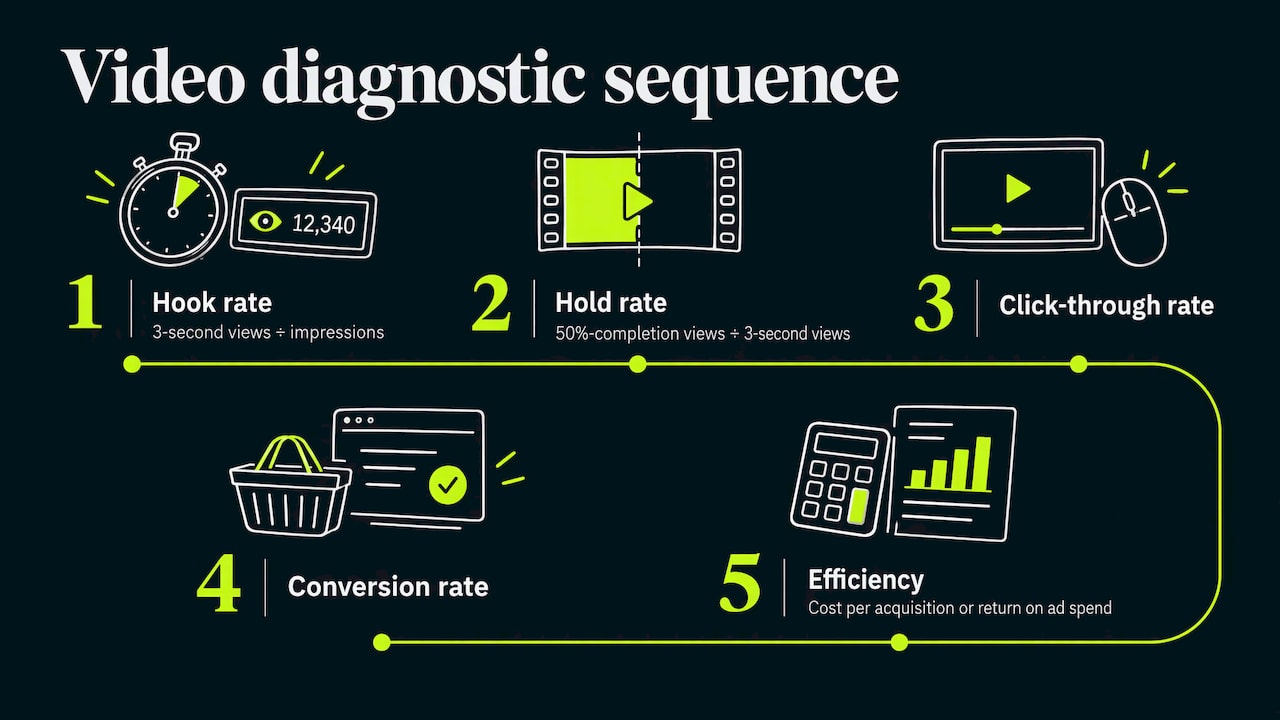
For video, two diagnostic metrics do much of the work. Hook rate is 3-second views divided by impressions, and hold rate is 50%-completion views divided by 3-second views, as defined in one testing framework. Read results in funnel order: hook rate, hold rate, click-through rate, conversion rate, then cost per acquisition or return on ad spend.
If brand building is the goal, add brand-side measures. The commonly cited dimensions are message clarity, emotional resonance, brand attribution and action intent, and brand lift studies compare people who saw the ad with a control group to isolate the ad's contribution.
Decide what to vary
The most common design error is changing too much. One guide ranks elements by likely impact: hook in the first three seconds, then angle or message, then visual and format, then offer, then call to action and copy. Its warning is simple: swap hook and visual together and a win tells you nothing about which change caused it.
A sequence that keeps results readable
- Test concepts first. Start with three to five distinct creative concepts. These are different ideas, not tweaks.
- Iterate on the winner. Change one element at a time: alternative calls to action, different cuts and lengths, copy versions.
- Expect three outcomes. A statistically significant difference, no significant difference, or not enough data to conclude. A flat result is still information.
How big should the matrix be?
Variant matrices scale the work. One framework describes a 3-3-3 matrix, three concepts by three variations by three hooks, giving 27 assets for high-volume discovery, and a 3-2-1 matrix of six assets for mid-size teams. Twenty-seven finished films is a production project, not a media-buying task. That is why the choice of matrix should be made with your production team, not after the shoot.
Platform length matters too. On Twitter, assets up to six seconds delivered the highest ad recall lift, 20 percentage points, against 14 for six to fifteen seconds and 13 for longer. Length is a legitimate variable, but it belongs in its own test.
Producing video variations that stay comparable
This is where testing programmes for large brands tend to slow down. A test needs many versions; a brand needs every version to look and sound like the brand; broadcast and agency delivery needs every version to meet technical specs. Those three demands pull against each other.
Build in modules
The efficient pattern is modular. Plan interchangeable hooks, bodies and calls to action, and capture multiple opening lines, different footage styles and different close styles so they can be recombined. With AI-augmented production the same logic applies to generated and composited elements: a defined set of openings, product moments and end cards, assembled into the matrix you chose.
Keep everything but the test variable locked
For a fair comparison, these should be identical across versions unless they are the variable:
- Grade, colour treatment and sound mix
- Logo placement, end card and legal text
- Aspect ratio and safe areas for each placement
- Pacing outside the element under test
- Audio balance, so that the film works with and without sound
IAB Australia's list of video must-haves is a good checklist for what every version should carry: the full screen area (horizontal for desktop and connected TV, vertical for mobile), viewing with and without sound, a prominent product or offer, one primary message, brand cues throughout and the key message as early as possible.
If you pre-test with animatics or rough cuts, match the finished ad. Guidance on concept testing says to match duration, language, editing style, audio effects and supertext to the future finished ad and to test with the media-target audience, and to include variants such as different durations and endings.
Give someone ownership of approval
In-house optimisation teams typically separate roles: one group maintains a reusable library of components such as backgrounds, logos and video, while an approval team enforces brand, legal and compliance guidelines before anything goes live. Whether you run that in-house or with a production partner, the principle holds: approval criteria should be written before the variants are made, not argued after.
Where AI-augmented production fits
Getting one good shot from a prompt is the easy part. The hard part is turning AI output into a finished film that holds together from start to end, stays on brand and meets broadcast and agency delivery specs. Creative testing multiplies that problem, because you need many versions that are consistent with each other.
Craft Intelligence is designed for this. It combines specialist people, AI tools and tested production processes, orchestrating multiple tools, setting clear handoff standards between specialists and documenting quality checks at every stage. Directors, AI artists, editors and colourists apply judgement where it matters. The service covers versioning, VFX, compositing, conforming and grading, so each variant in your matrix reaches you as a finished, brand-safe deliverable rather than a raw generation.
What that means for a test:
- Planning. Your test card tells the team which element varies. Human creative direction holds everything else constant.
- Production. AI tools widen the range of hooks, scenes and treatments you can try, within a controlled workflow.
- Finishing. Conform and grade are applied consistently across versions, so differences in results come from the idea and not from uneven finishing.
- Delivery. Outputs are prepared to broadcast and agency specs.
Working with us
If you are planning a testing programme and want the variations produced to a consistent standard, our AI production service is built for brand marketing teams, agencies and media owners who want the speed and range of AI with the craft standards of a live-action shoot. Craft Intelligence was developed by BearJam, an award-winning London video production studio founded in 2012.
Bring the test card to the first conversation. Knowing the hypothesis, the single variable and the placements lets the production plan be built around the test from the start. You can read more about the approach on the Craft Intelligence site.
Reading the results
A result is ready to act on when it clears pre-agreed thresholds, not when a dashboard first shows a leader.
Rules of thumb for calling a winner
One framework suggests graduating a winner only when thresholds are met, there is a clear advantage on two or more diagnostic metrics, and the result is stable for five or more days. The same framework asks for 80% directional confidence on iteration tests and 95% on holdout tests, and longer windows where iOS attribution delays conversions. A review of testing practice reports that many advertisers end tests too early and decide on noise, so build the minimum duration into the test card.
Interpret with the brand in mind
- Do not read engagement alone. As the TikTok analysis above shows, engagement rate explains very little of brand memory lift, while creative quality and emotional response explain far more.
- Check that the message was understood. In one benchmark, not understanding the ad was the biggest single driver of dislikes, and understanding it was the biggest driver of likes.
- Segment where it matters. Different audiences can respond to different treatments, for example humour for one generation and clean layouts for another. Run segment-specific tests rather than assuming one winner fits all.
Build a learning log
Teams gain most not from bigger studies but from running them regularly and documenting which messages underperform, which emotional frames drive action and which visual conventions confuse. Keep a simple record for every test: hypothesis, variants, spend, outcome and what you will change next. It also becomes the brief for the next round of production.
Common mistakes and how to avoid them
| Mistake | How to avoid it |
|---|---|
| Changing several elements at once | One variable per test, chosen from the impact hierarchy |
| Uneven spend between versions | Equal budgets per cell, and only one difference between cells |
| Ending tests early | Set minimum conversions and days in the test card |
| Variants that differ in finish or brand treatment | Lock grade, sound, logo and end cards across versions |
| Pre-testing rough work that does not resemble the final ad | Match duration, edit style and audio to the finished film |
| Reading only click metrics | Add brand recall and message clarity to the scorecard |
| No record of results | Keep a learning log and feed it into the next brief |
Complexity and uncertainty also push organisations toward false readings of results, which can lead to funding productions that will not work or missing useful insights. The remedy is a clear process and, in the same guide's words, pairing technology's speed and scale with the human touch of expert storytelling.
FAQ
What is the difference between creative testing and A/B testing?
A/B testing is one method of creative testing: two versions run against each other in market. Creative testing is broader and also includes pre-launch research with real people, multivariate tests and lift studies against a control group. Teams often use survey-based pre-testing to choose a concept and A/B testing to refine it.
How many video variations should we make?
Start with three to five distinct concepts, then iterate on the winner by changing one element at a time. A mid-size programme might use a six-asset matrix, while high-volume teams use larger ones such as 27 assets. Choose the size your budget can support with enough conversions per variant.
How long should a creative test run?
Planning ranges from practitioner guides run from three to four days at the low end to seven days or more, with longer where conversions are delayed. Set the minimum in the test card and do not stop before it, even if one version appears to lead.
Which element of a video ad should we test first?
Usually the hook, the first three seconds, because it determines whether people keep watching. After that, test the angle or message, then visual and format, then offer, then call to action.
How do we keep AI-generated variations on brand?
Define what is locked (grade, sound, logos, end cards, safe areas) before production, and give approval to a named owner with written criteria. Human creative direction and documented quality checks at each stage keep every version consistent and brand-safe.
Sources
- Creative Testing: Definition, Process, and Metrics
- What Is Creative Testing?
- Creative Testing Strategies for Scaling Ad Campaigns
- State of Creative Effectiveness 2025
- The Creator Effectiveness Playbook
- A Guide to Designing Digital Ad Impact Studies
- Creative Testing Playbook
- Creative Testing: Budget, Metrics and Test Plan
- Ultimate Guide to Creative Testing in 2026
- A Creative Testing Framework That Actually Scales
- Ad Creative Testing: Ensuring Your Ads Resonate
- The Complete Guide to Creative Testing
- Creativity in Video, IAB Australia
- How to Mass Produce Facebook Ad Creatives: A 2026 Playbook
- The definitive guide to creative
- How to Build an In-House Creative Optimization Team
- What is creative testing and how to apply this approach
Made with BabyLoveGrowth to grow visibility across Google and AI search